
Retaining walls are built using concrete blocks. Each block is individually installed to create the final wall face. Often referred to as concrete wall blocks or CRB units, these are installed at specific angles for applications at cut slopes, attenuation ponds and embankments.
Why use CRB units for retaining walls?
Due to their shapes and unique structures, the CRBs can be laid at angles from 70 to 90 degrees without having to use a cement mix for improved adhesion and stability. This reduces the time it takes to complete the walls, helping to reduce the cost of labour and thereby the overall cost of the project.
Factors that affect the cost of retaining walls
Several factors contribute to the cost of building a concrete retaining wall. The first is the type and size of CRBs used. Other factors to consider include:
- Whether it’s an open or closed-face design.
- Structure height.
- How easy it is to reach the work area.
- Whether you use coloured or grey types since the coloured CRBs are the more expensive option.
- Angle at which the wall is constructed.
- Horizontal footprint of the wall.
Types of concrete blocks for retaining walls
We offer an extensive range of CRBs to meet your commercial, industrial, and residential application needs. Our products are SABS approved, giving superb quality assurance. This is important as the quality of the materials is one of the important factors to consider. As these walls have to keep heavy soil from moving onto a lower-lying area and must carry considerable weight, the structural strength of the material is crucial to ensure durability and safety of the structure. We manufacture and supply the following types:
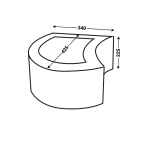
MVA 7

38kg /block
36 blocks /pallet
*sans mark approved
The MVA 7 type can be used with slider panel blocks, depending on whether it’s an open or closed face design.

Can plants be grown in all types of retaining walls systems?
Yes. All blocks form a specialised cavity for planting except those with closed faced walls. For guaranteed planting success, It’s best to enquire from the supplier about the suitability of the particular design and block type for propagating plants.
Compaction factor
If the backfill is not compacted enough and in the correct manner, the risk of wall structure failure increases. It’s for this reason you need an engineer to approve the compaction according to their specific instructions if it’s a high wall. The CRBs must also be able to facilitate the required compaction to ensure the stability of the wall.
Three important factors for retaining wall structural integrity
The appropriate foundation, correct backfill, and drainage layer are factors often overlooked by DIY enthusiasts or inexperienced contractors. The drainage layer should also be compacted according to the engineer’s instructions. For lower walls, you can use a gravel foundation, but for higher wall structures, a stronger foundation is essential. With a concrete foundation, you’ll need to set the first row of CRBs with the use of a cement mix.
How to decide on the type of concrete blocks
Sources – https://www.terraforce.com/benefits-and-features/questions-and-answers